

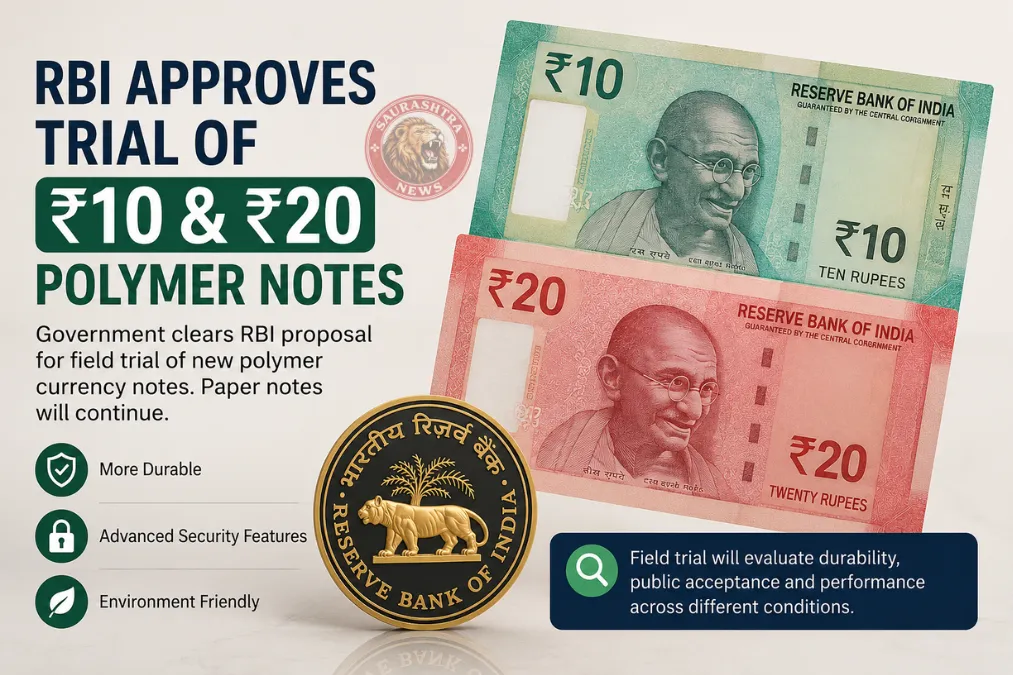
RBI Polymer Notes: Government Approves Trial of ₹10 and ₹20 Polymer Currency, Paper Notes to Continue

India could soon take a step toward introducing RBI Polymer Notes for ₹10 and ₹20 denominations after the Central Government approved a proposal from the Reserve Bank of India (RBI) to conduct field trials. The move marks an important milestone in the country’s efforts to explore more durable and secure currency, although the new notes are not set to replace existing paper currency anytime soon.
Officials have clarified that the approval is only for a pilot phase. The polymer notes will be tested under real-world conditions before any decision is made about introducing them into regular circulation across the country.
Government Clears RBI Proposal for Polymer Note Trial
The proposal was submitted by the Reserve Bank of India based on recommendations from its Central Board of Directors. According to the government, the approval has been granted under the provisions of the Reserve Bank of India Act, 1934, allowing RBI to move ahead with a large-scale field trial.
As part of the pilot project, the central bank plans to issue up to 100 crore polymer notes in the ₹10 and ₹20 denominations. These notes will be circulated in selected areas to evaluate how they perform during everyday use.
The approval does not mean the notes will immediately become part of India’s regular currency system. Instead, the field trial is intended to provide data that will help policymakers determine whether polymer notes are suitable for nationwide use.
What Will the RBI Field Trial Evaluate?
The upcoming trial will focus on several practical aspects of the new currency. RBI aims to understand how polymer notes perform under different environmental and usage conditions before making any long-term policy decisions.
The trial will examine factors such as:
- How well the notes withstand frequent handling.
- Their durability in different climatic conditions across India.
- Public acceptance and ease of use.
- Performance during routine banking and commercial transactions.
- Overall cost-effectiveness compared to conventional paper currency.
Only after reviewing the findings from the field trial will the RBI decide whether polymer notes should be introduced on a wider scale.
Existing Paper Notes Will Remain Valid
One of the biggest concerns among the public has been whether the introduction of RBI Polymer Notes would result in existing paper currency becoming invalid.
The government has addressed this concern by stating that there is no plan to withdraw the current ₹10 and ₹20 paper notes. Even if the polymer notes are introduced after successful trials, both paper and polymer versions may continue circulating together based on the country’s currency requirements.
This means people will not need to exchange their existing notes or worry about the legal status of current paper currency.
Why Is RBI Considering Polymer Notes?
Many countries have adopted polymer banknotes because they generally last much longer than traditional paper notes. Since low-value denominations such as ₹10 and ₹20 change hands frequently, they wear out faster and require regular replacement.
Polymer notes are designed to remain usable for a longer period, reducing the need for frequent printing and replacement. This can help lower the long-term costs associated with currency production and distribution.
The RBI has been examining whether these advantages could make polymer currency a practical option for India’s financial system, particularly for denominations that experience heavy circulation.
Security Features Could Make Counterfeiting More Difficult
Apart from improved durability, polymer notes also offer opportunities to incorporate advanced security features.
Modern polymer banknotes can include elements such as:
- Transparent security windows.
- Enhanced security threads.
- Advanced anti-counterfeiting features.
- Improved printing technologies that are difficult to replicate.
These features can strengthen protection against counterfeit currency while making genuine notes easier for the public and financial institutions to verify.
Several countries already use polymer currency for this reason, reporting improvements in both note longevity and counterfeit resistance.
Potential Economic and Environmental Benefits
If the field trial proves successful, polymer notes could provide benefits beyond durability.
Because they last longer, fewer replacement notes may need to be printed over time, potentially reducing production and distribution costs. Lower demand for replacement currency may also decrease paper consumption and reduce waste generated from worn-out notes.
While the initial manufacturing cost of polymer notes can be higher than paper currency, their longer lifespan often offsets that expense over time. The RBI’s field trial is expected to assess whether these long-term advantages apply under Indian conditions.
What Happens Next?
The approval from the Central Government is the first step in a structured evaluation process rather than an immediate currency change.
The RBI will now prepare for the field trial by releasing the approved quantity of ₹10 and ₹20 polymer notes in selected areas. Officials will monitor their durability, usability, public response, and overall performance across different regions and weather conditions.
Only after the trial is completed and the results are carefully analyzed will a final decision be made on whether RBI Polymer Notes should become part of India’s regular currency circulation.
For now, citizens can continue using their existing ₹10 and ₹20 paper notes as usual. The proposed polymer notes represent a potential modernization of India’s currency system, but any nationwide rollout will depend entirely on the outcome of the field trial and the RBI’s final assessment.