

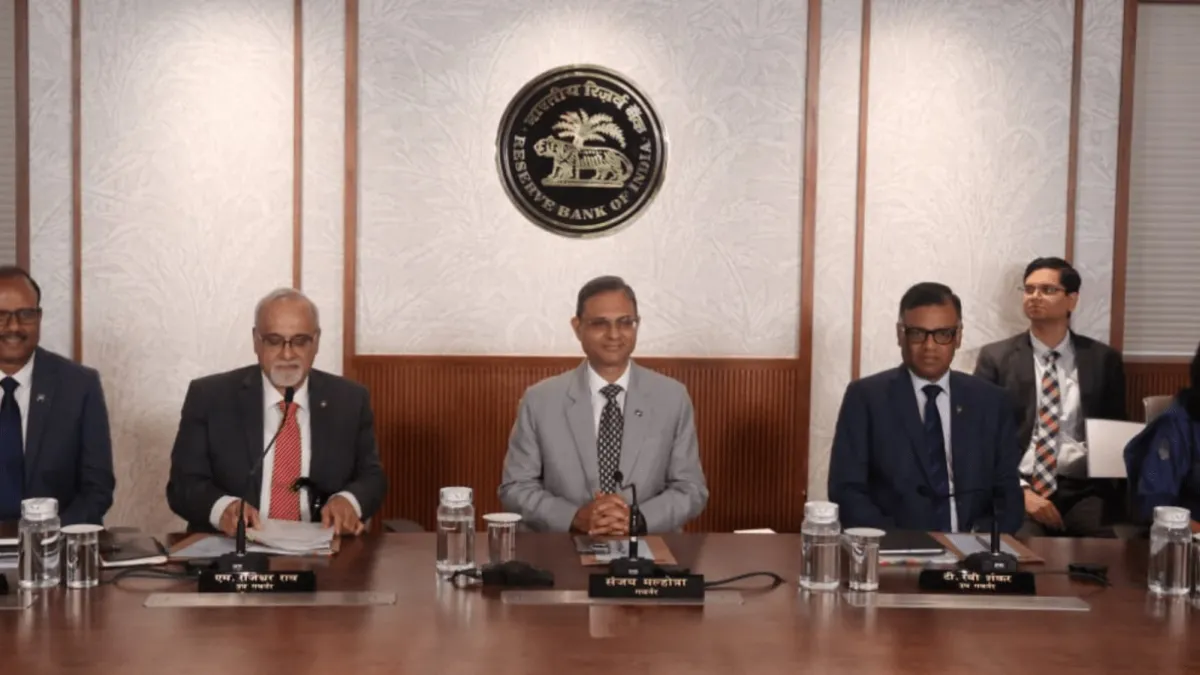
RBI MPC Meeting April 2026: RBI Keeps Repo Rate Unchanged Again, Borrowers Won’t See Cheaper Loans Yet

The Rbi mpc meeting april 2026 concluded with the Reserve Bank of India deciding to keep its key policy rates unchanged for the second consecutive time. The decision means borrowers hoping for cheaper loans or lower EMIs will have to wait longer.
During the announcement of the first monetary policy of the financial year 2026–27, RBI Governor Sanjay Malhotra said the central bank has chosen to maintain the current interest rate structure because inflation risks remain present and global economic conditions are uncertain. While India’s economy continues to show resilience, the central bank believes it is necessary to remain cautious before making any changes to borrowing costs.
The policy announcement followed the three-day meeting of the Monetary Policy Committee (MPC) held between April 6 and April 8.
Repo Rate Remains at 5.25%
At the center of the Rbi mpc meeting april 2026 was the decision to keep the repo rate unchanged at 5.25 percent. The repo rate is the rate at which the Reserve Bank of India lends money to commercial banks, and it plays a crucial role in determining lending rates across the economy.
With the repo rate staying the same, banks are unlikely to reduce their lending rates immediately. This means that new borrowers will not see cheaper loans and existing borrowers will not get relief in the form of lower monthly EMIs.
The reverse repo rate, which is the rate at which banks park their surplus funds with the RBI, also remains unchanged.
For millions of borrowers across India—from home loan customers to small business owners—the decision signals that the cost of borrowing will remain steady for now.
RBI Maintains Neutral Monetary Policy Stance
The central bank also confirmed that its policy stance remains neutral. This means the Monetary Policy Committee has the flexibility to either increase or decrease interest rates in the future depending on economic developments.
Governor Malhotra emphasized that maintaining a neutral stance allows the RBI to respond quickly to changing conditions, especially when global uncertainties are still affecting financial markets and inflation trends.
He explained that while India’s economic fundamentals remain strong, the central bank is closely monitoring inflation trends before making any major policy shifts.
Inflation Remains a Key Concern
One of the primary reasons behind the RBI’s cautious approach in the Rbi mpc meeting april 2026 is the risk of rising inflation.
The central bank has projected that retail inflation for the upcoming financial year could average 4.6 percent. According to RBI estimates:
- Q1 FY2027: 4.0 percent
- Q2 FY2027: 4.4 percent
- Q3 FY2027: 5.2 percent
- Q4 FY2027: 4.7 percent
These projections indicate that inflation could temporarily rise above the RBI’s comfort zone during certain quarters.
The central bank’s inflation target is 4 percent with a tolerance band of 2 percent on either side. If inflation rises significantly, the RBI may consider tightening policy again to control price pressures.
Governor Malhotra noted that maintaining price stability remains the central bank’s top priority, as high inflation directly affects household budgets and economic growth.
India’s Economy Showing Strong Growth
Despite inflation concerns, the RBI expressed confidence in the strength of India’s economy.
The central bank has revised its GDP growth forecast for the financial year 2025–26 to 7.6 percent, reflecting stronger-than-expected economic activity.
For the current financial year 2026–27, the RBI expects the Indian economy to grow at around 6.9 percent.
India continues to benefit from robust domestic demand, increasing infrastructure investments, and a steady recovery in key sectors such as manufacturing and services.
However, the RBI warned that global developments—including geopolitical tensions and economic slowdowns in major economies—could influence growth in the coming months.
Global Uncertainty Influencing Policy Decisions
Governor Malhotra highlighted that the global economic environment remains unpredictable.
He pointed to ongoing geopolitical tensions in regions such as the Middle East and fluctuations in global commodity prices as factors that could impact inflation and financial stability.
Central banks worldwide are currently navigating a complex environment where inflation risks, supply chain disruptions, and currency fluctuations continue to influence economic decisions.
The RBI’s cautious stance during the Rbi mpc meeting april 2026 reflects its attempt to balance economic growth with price stability.
RBI Reviews Monetary Policy Every Two Months
The Reserve Bank of India reviews its monetary policy every two months through meetings of the six-member Monetary Policy Committee.
The committee includes the RBI governor, senior officials from the central bank, and external economists appointed by the government.
The April policy meeting marked the first monetary policy review of FY2026–27, following the previous MPC meeting held in February 2026.
During the February meeting, the RBI had also decided to keep interest rates unchanged, making the April decision the second consecutive pause in policy rates.
Markets React Positively Ahead of Policy Announcement
Financial markets showed strong momentum ahead of the policy announcement.
The Indian stock market experienced a sharp rally, with the Sensex gaining around 2,700 points and the Nifty rising more than 750 points during trading.
Market optimism was partly driven by international developments, including reports of a ceasefire announcement between the United States and Iran, which boosted investor confidence globally.
Asian markets also showed strong gains, reflecting improved sentiment across global financial markets.
Meanwhile, the Indian rupee strengthened by 36 paise against the US dollar, indicating improved investor confidence and capital inflows.
What the Decision Means for Borrowers
For individuals planning to take loans—especially home loans, car loans, or personal loans—the outcome of the Rbi mpc meeting april 2026 means borrowing costs will remain unchanged for now.
Since banks typically adjust lending rates based on the repo rate, the decision to keep the rate steady means there will be no immediate reduction in loan interest rates.
Existing borrowers paying EMIs on floating-rate loans may also have to wait longer for any relief.
However, financial experts believe that if inflation shows signs of easing in the coming months, the RBI could consider rate cuts in future policy meetings.
Outlook for Future RBI Policy Decisions
Looking ahead, the RBI’s next policy decisions will likely depend on several factors, including:
- Inflation trends in India
- Global economic stability
- Commodity prices, especially crude oil
- Currency movements and capital flows
- Domestic economic growth indicators
If inflation remains under control and economic growth slows, the central bank may consider lowering interest rates to stimulate borrowing and investment.
On the other hand, if inflation rises unexpectedly, the RBI could maintain its cautious approach or even consider tightening policy again.
Also Read: Gujarat RFO Transfer: Major Overhaul in Forest Department After Long-Pending Changes
Conclusion
The Rbi mpc meeting april 2026 delivered a clear message: the Reserve Bank of India is prioritizing economic stability and inflation control over short-term relief in borrowing costs.
By keeping the repo rate unchanged at 5.25 percent for the second time in a row, the RBI has signaled that it wants to closely monitor inflation and global developments before making any policy adjustments.
While borrowers may be disappointed by the lack of immediate relief in loan EMIs, the central bank’s cautious strategy aims to ensure long-term economic stability.
With India’s economy continuing to show resilience despite global challenges, the coming months will play a crucial role in determining whether the RBI shifts its policy direction or maintains its current stance.