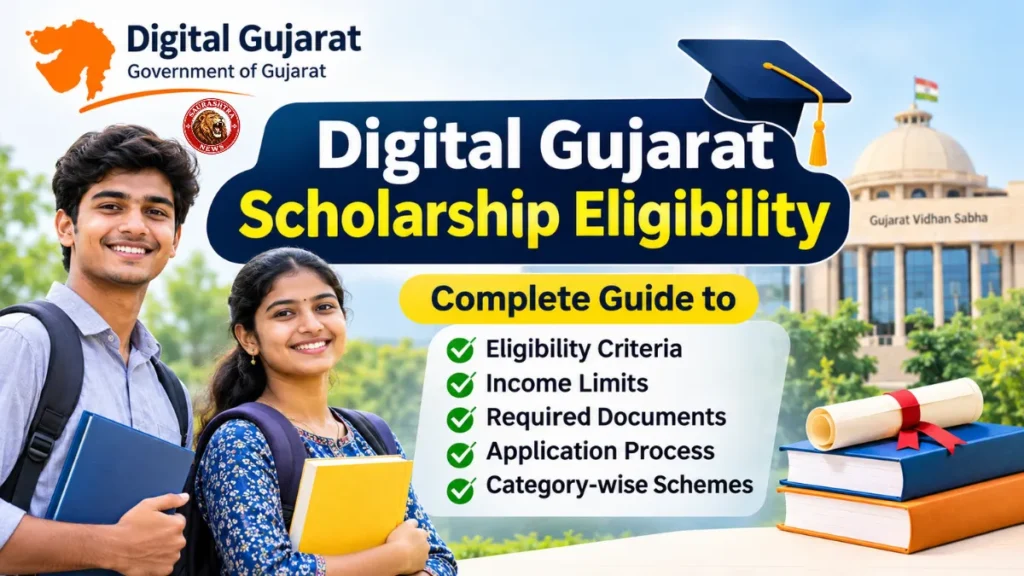
Digital Gujarat Scholarship eligibility is one of the most important things students need to understand before applying for financial assistance through the Gujarat Government. The Digital Gujarat Scholarship portal provides access to different scholarship schemes designed to help students from economically weaker families and various eligible social categories continue their education without facing unnecessary financial difficulties.
The Gujarat Government offers several scholarships for school students, college students, undergraduate students, postgraduate students and students pursuing professional courses. These schemes are intended to reduce the financial burden of education by providing assistance for tuition fees, maintenance expenses and other educational costs, depending on the particular scholarship.
However, not every student can apply for every scholarship. Each scheme has its own eligibility conditions, income limits, educational requirements and documentation rules. Students must understand these conditions before submitting an application.
In this detailed guide, we will explain Digital Gujarat Scholarship eligibility, category-wise requirements, family income limits, educational qualifications, required documents and the online application process.
What Is the Digital Gujarat Scholarship?
Digital Gujarat Scholarship is a collection of financial assistance schemes offered by the Gujarat Government through its online service portal. These schemes are managed by different government departments, including the Social Justice and Empowerment Department, Tribal Development Department and other welfare departments.
The main purpose is to support students who belong to Scheduled Castes (SC), Scheduled Tribes (ST), Socially and Educationally Backward Classes (SEBC), Other Backward Classes (OBC), Economically Backward Classes (EBC), minority communities and other eligible groups.
Students can use the portal to find scholarship schemes, submit applications, upload documents and check application progress.
Some scholarships are available for students studying in primary and secondary schools, while others support students pursuing higher secondary education, graduation, postgraduation, diploma, ITI and professional courses.
The important thing to remember is that Digital Gujarat is a common application platform. Eligibility is decided by the rules of the individual scholarship scheme, not simply by having a registered account on the portal.
Digital Gujarat Scholarship Eligibility: Who Can Apply?
The eligibility criteria depend on the scholarship category, educational qualification, family income and other conditions mentioned in the scheme guidelines.
Generally, students may qualify for a scholarship if they meet the following conditions:
- The applicant must satisfy the Gujarat domicile or residence requirements of the selected scheme.
- The student must belong to an eligible social or economic category, wherever applicable.
- The applicant must be studying in a recognised school, college or educational institution.
- The family income must fall within the prescribed limit for that scholarship.
- The student must have the required educational qualifications and previous examination results.
- The applicant must provide valid supporting documents.
- The student must follow the rules regarding attendance, admission and academic progress, wherever applicable.
Some schemes are specifically designed for particular communities, while others are available to students from different categories based on merit and financial conditions.
For example, post-matric scholarships generally support students studying after Class 10, whereas pre-matric scholarships are intended for school students.
Different Types of Digital Gujarat Scholarship Schemes
Before checking the income limit or educational requirements, students should understand the major scholarship categories available through the portal.
1. Pre-Matric Scholarship
Pre-matric scholarships are designed for students studying in primary and secondary classes.
These scholarships help families manage educational expenses and encourage children to continue their studies.
Depending on the scheme, students from Classes 1 to 10 may qualify. However, the eligible classes, school requirements and family income conditions can differ.
For example, the pre-matric scholarship for SEBC students has different income conditions for students studying in Classes 1 to 8 and Classes 9 to 10.
2. Post-Matric Scholarship
Post-matric scholarships are generally available to students who have passed Class 10 and are continuing their education.
Eligible courses may include:
- Class 11 and Class 12
- Undergraduate degree courses
- Postgraduate courses
- Diploma programmes
- ITI courses
- Medical and engineering courses
- Other recognised professional courses
The scholarship may cover tuition fees, maintenance allowances and other approved educational expenses, depending on the scheme.
3. Scholarship for SC Students
Scheduled Caste students can apply for different educational assistance schemes through the Digital Gujarat portal.
These include post-matric scholarships, financial assistance for professional courses and other educational support programmes.
Students must provide the required SC caste certificate and income certificate wherever applicable.
4. Scholarship for ST Students
Scheduled Tribe students can benefit from scholarship schemes managed by the Tribal Development Department.
These schemes may cover students studying in higher secondary schools, colleges and professional institutions.
The required documents and family income limits depend on the specific ST scholarship.
5. Scholarship for SEBC and OBC Students
Students belonging to Socially and Educationally Backward Classes and eligible OBC communities can apply for different pre-matric and post-matric schemes.
These programmes are intended to support students who need financial assistance to continue their education.
6. Scholarship for Minority Students
Certain scholarship schemes are also available for students belonging to eligible minority communities.
Depending on the scheme, students may need to provide a minority community declaration, income certificate and academic records.
Students should check whether the particular scholarship is currently available through Digital Gujarat or another government scholarship platform.
Digital Gujarat Scholarship Eligibility Based on Family Income
Family income is one of the most important factors when applying for a scholarship.
The Gujarat Government has established different income limits for different schemes. A student who qualifies under one scholarship may not necessarily qualify under another.
For example, certain post-matric scholarship schemes for SC, ST and SEBC students use an annual family income ceiling of Rs. 2.50 lakh. Other schemes have different limits or special provisions.
Here is a general overview of commonly encountered income requirements.
| Scholarship category | General income condition |
|---|---|
| SC Post-Matric Scholarship | Up to Rs. 2.50 lakh under the relevant scheme |
| ST Post-Matric Scholarship | Up to Rs. 2.50 lakh under the standard scheme, with certain special provisions |
| SEBC Post-Matric Scholarship | Depends on the specific scheme |
| OBC PM-YASASVI Post-Matric Scholarship | Up to Rs. 2.50 lakh under applicable guidelines |
| Minority Scholarships | Depends on the applicable scheme |
| Pre-Matric SEBC Scholarship | Different conditions for different school classes |
These figures should not be treated as universal income limits for every scholarship available on the portal.
Students should check the latest government notification before applying because income conditions can change between academic years.
For income verification, an official income certificate issued by the competent authority may be required. The certificate should contain correct family income information.
Educational Qualification Required for Digital Gujarat Scholarship
Educational qualifications are another important part of Digital Gujarat Scholarship eligibility.
The government offers scholarships for different levels of education, so students should select a scheme that matches their current course.
School Students
Students studying in eligible primary and secondary classes can apply for applicable pre-matric scholarships.
The school must satisfy the conditions mentioned in the selected scheme. Some scholarships are limited to government and grant-in-aid schools.
Higher Secondary Students
Students studying in Classes 11 and 12 can apply for eligible post-matric and higher secondary scholarship schemes.
They may need to submit their Class 10 marksheet, current admission details and school certificate.
Undergraduate Students
Students pursuing courses such as BA, BCom, BSc, BBA, BCA and other recognised undergraduate programmes may qualify for relevant scholarship schemes.
The course, institution and admission type must meet the conditions of the selected scheme.
Postgraduate Students
Students pursuing MA, MSc, MCom, MBA and other postgraduate courses may also qualify under certain scholarship programmes.
Some schemes have additional conditions relating to previous academic performance and course recognition.
Professional Course Students
Students studying medicine, engineering, pharmacy, nursing, architecture and other professional courses can check the relevant scholarship options.
Certain schemes also provide additional assistance for food bills, educational instruments and professional course expenses.
Digital Gujarat Scholarship Eligibility for Different Categories
The Gujarat Government provides different scholarship opportunities according to students’ social and economic backgrounds.
Eligibility for SC Students
Students belonging to the Scheduled Caste category can apply for scholarships offered through the Scheduled Caste Welfare Department.
Common requirements include:
- A valid SC caste certificate.
- Admission to an eligible recognised institution.
- Previous academic records.
- Income certificate, where required.
- Bank account details.
- Compliance with the selected scholarship’s course and admission conditions.
The post-matric scholarship is particularly useful for SC students who want to continue their education after Class 10.
Eligibility for ST Students
Scheduled Tribe students can apply for scholarships offered under the Tribal Development Department.
The applicant generally needs a valid ST certificate and admission to an eligible course.
For the standard post-matric scholarship, an annual family income limit of Rs. 2.50 lakh is commonly applicable. However, special schemes may cover different income groups.
For example, certain schemes provide separate assistance to eligible ST girl students whose family income exceeds Rs. 2.50 lakh.
Students should carefully read the current scheme notification before submitting an application.
Eligibility for SEBC Students
SEBC students can apply for various educational assistance schemes.
The main requirements generally include:
- A valid SEBC caste certificate.
- Admission to an eligible educational institution.
- An income certificate if required.
- Previous examination marksheets.
- Bank account information.
- Other documents specified by the department.
Some schemes are available for boys and girls, while certain schemes have separate conditions for female students.
Eligibility for OBC and EBC Students
Eligible OBC and EBC students may receive financial assistance through applicable state and centrally sponsored scholarship schemes.
Students applying under PM-YASASVI or other post-matric schemes should check the community certificate, income limit and course requirements.
It is important to understand that OBC and SEBC classifications are not automatically interchangeable for every scholarship. Applicants must use the category recognised under the relevant scheme.
Eligibility for Minority Students
Students from eligible minority communities can check scholarship opportunities available through the relevant government departments.
The eligible communities, income limits, academic requirements and application platforms depend on the scheme.
Students should verify the current application notification because scholarship availability and administrative arrangements can change from one academic year to another.
Documents Required for Digital Gujarat Scholarship
Having the correct documents is essential for a successful scholarship application. If any document is missing, unclear or contains incorrect information, the application may be delayed or returned for correction.
Students should keep the following documents ready before starting the application.
1. Aadhaar Card
An Aadhaar card may be required to verify the student’s identity. The name and other personal details should match the information entered in the application.
2. Income Certificate
An income certificate is required for scholarships that have an annual family income limit.
It should be issued by the authorised government authority. Students should ensure that the certificate is valid for the relevant academic year, according to the scheme requirements.
3. Caste Certificate
Students applying under SC, ST, SEBC or other eligible reserved categories may need to submit a valid caste certificate.
The certificate should be issued by the competent government authority.
4. Previous Year Marksheet
The previous examination marksheet is generally required to verify academic performance and educational qualifications.
For example, a student applying for a college scholarship may need to upload the Class 12 marksheet.
5. Admission or Bonafide Certificate
A bonafide certificate or admission confirmation may be required to prove that the student is currently studying at a recognised educational institution.
6. Bank Passbook
Students may need to provide a copy of their bank passbook showing the account holder’s name, account number and IFSC code.
The bank details must be accurate because scholarship payments may be transferred directly to the eligible student’s bank account.
7. Passport-Size Photograph
A recent passport-size photograph may be required during online registration or application submission.
8. Fee Receipt
Students studying in colleges or professional institutions may need to upload their current academic year’s fee receipt.
This document helps verify the admission and educational expenses claimed under the scholarship.
9. Other Required Certificates
Depending on the scheme, students may also need additional documents, such as:
- Disability certificate.
- Hostel certificate.
- Leaving certificate.
- Free Ship Card.
- Domicile or residence proof.
- Course-related documents.
Not every scholarship requires all these documents. Applicants should follow the document checklist displayed for their selected scheme.
How to Apply for Digital Gujarat Scholarship Online
Students who meet the eligibility conditions can submit their scholarship applications online through the Digital Gujarat portal.
The application process is straightforward, but applicants should enter their information carefully.
Step 1: Visit the Official Digital Gujarat Portal
Open the official Digital Gujarat website and find the student registration or login option.
Make sure you are using the government portal rather than an unofficial website.
Step 2: Complete Student Registration
New applicants need to create an account by providing the required personal details.
These may include:
- Student’s full name.
- Mobile number.
- Email address.
- Aadhaar-related details, where required.
- Other basic information.
Use an active mobile number because it may be needed for verification and future communication.
Step 3: Log In to Your Account
After completing registration, log in using the registered credentials.
Students should keep their login information safe because they may need it to check application status or submit renewal applications.
Step 4: Complete Your Profile
Fill in the personal, educational and residential information requested on the portal.
Make sure your name, date of birth, category and other details match your official documents.
Incorrect information can create problems during document verification.
Step 5: Select the Appropriate Scholarship Scheme
Go to the scholarship or service section and select the scheme for which you want to apply.
Read the eligibility conditions carefully before proceeding.
For example, an SC student should select the relevant SC scholarship rather than applying under an unrelated category.
Step 6: Fill in the Application Form
Enter all the required details, including educational information, institution details, family income and bank account information.
Check every field before moving to the next step.
Step 7: Upload Required Documents
Upload clear copies of the documents requested by the portal.
Make sure that the documents are readable and follow the prescribed file format and size requirements.
Step 8: Review and Submit the Application
Before submitting the form, review all the information.
Check your personal details, bank information, educational records and uploaded documents.
Once everything is correct, submit the application.
Step 9: Save the Application Number
After successful submission, save the application number or acknowledgement details.
These details may be useful when checking the application status or contacting the concerned department.
How to Check Digital Gujarat Scholarship Application Status
After submitting the application, students should regularly check its status.
The application may pass through different verification stages before the scholarship is approved.
To check the status, follow these steps:
- Visit the official Digital Gujarat portal.
- Log in using your registered account.
- Open the application or service history section.
- Find your submitted scholarship application.
- Check the latest status displayed on the screen.
Depending on the department and scheme, the application may show different stages.
Application Submitted
This generally means that the student has successfully submitted the application online.
However, submission does not mean that the scholarship has been approved.
Under Verification
The application is being checked by the concerned school, college or government department.
Officials may verify the student’s eligibility, documents and academic details.
Pending for Correction
If any information or document is incorrect or incomplete, the application may be returned for correction.
Students should check the remarks carefully and make the required changes within the permitted time.
Approved
An approved application means that the concerned authority has accepted the application at the relevant approval stage.
Students should still check whether the payment has been processed.
Rejected
An application may be rejected if the student does not meet the eligibility conditions, provides incorrect information or fails to submit the required documents.
The reason for rejection should be checked before considering any further action.
Important Reasons Why Digital Gujarat Scholarship Applications Get Rejected
Even students who appear to meet the basic eligibility conditions can face application problems.
Here are some common reasons why scholarship applications may be rejected or delayed.
Incorrect Personal Information
A mismatch in the student’s name, date of birth or other personal details can create verification problems.
Always enter information exactly as mentioned in the relevant official documents.
Invalid Income Certificate
An expired certificate or a document issued by an unauthorised person may not be accepted.
Students should check the certificate requirements before uploading it.
Wrong Scholarship Selection
Selecting a scholarship that does not match the student’s category, course or educational level can result in rejection.
Read the scheme conditions carefully before applying.
Incorrect Bank Details
Wrong account numbers, IFSC codes or mismatched account holder details can create payment difficulties.
Students should verify their bank information before submitting the form.
Missing Documents
If the application requires a caste certificate, marksheet, fee receipt or bonafide certificate, failing to upload the document can delay the process.
Not Meeting Academic Requirements
Some scholarships have minimum marks or previous examination conditions.
Students who do not meet these requirements may not qualify even if their family income is within the prescribed limit.
Important Points Students Should Know Before Applying
Understanding a few important rules can help students avoid unnecessary problems.
First, registering on the Digital Gujarat portal does not automatically make a student eligible for financial assistance. Eligibility depends on the selected scholarship scheme.
Second, students should not assume that every scholarship has the same income limit. The income criteria for SC, ST, SEBC, OBC, minority and other schemes may be different.
Third, students should check whether their educational institution and course are recognised under the selected scheme.
Fourth, applicants should provide genuine documents and accurate information. Incorrect details can lead to rejection or other administrative action.
Fifth, students applying for renewal should check whether they need to submit fresh academic documents, admission details and income certificates.
Finally, scholarship deadlines are important. Applications submitted after the prescribed closing date may not be accepted unless the government officially extends the deadline.
Difference Between Fresh and Renewal Scholarship Applications
Digital Gujarat scholarship applicants may be required to submit either a fresh application or a renewal application.
Understanding the difference is important for students who have already received scholarship assistance.
Fresh Application
A fresh application is generally submitted by students applying for a particular scholarship for the first time.
New applicants need to provide their personal information, educational qualifications, category details and supporting documents.
Renewal Application
A renewal application is generally meant for students who received the scholarship during the previous academic year and want to continue receiving assistance.
Depending on the scheme, renewal applicants may need to provide:
- Previous year’s scholarship details.
- Current academic year admission proof.
- Latest marksheet.
- Updated income certificate, if required.
- Current fee receipt.
- Other documents requested by the department.
Renewal is not automatic. Students must satisfy the applicable academic and administrative conditions for the next year.
Also read: Driving License Address Change Online: Complete Step-by-Step Process
Where Can Students Get Help Regarding Digital Gujarat Scholarship?
Students who face problems during registration, document uploading or application submission can seek assistance through official support channels.
They can contact their school or college scholarship department for help with institution-level verification.
They can also visit a nearby Jan Seva Kendra or the concerned government department for guidance.
The Digital Gujarat helpdesk number listed by Gujarat government district administration services is 1800-233-5500. Students should verify the current contact details before calling. India+1
For scheme-related questions, applicants should contact the department responsible for their particular scholarship.
Conclusion
Digital Gujarat Scholarship eligibility is an important factor for students who want to receive financial assistance from the Gujarat Government. Through different scholarship programmes, the government aims to support students from economically weaker families and eligible social categories.
Whether a student is studying in school, college, university or a professional institution, there may be a suitable scholarship scheme available, depending on the eligibility conditions.
Before applying, students should carefully check the family income limit, caste category requirements, educational qualifications and necessary documents. They should also make sure that all the information entered in the online application is correct.
The best way to avoid mistakes is to read the latest government guidelines and apply under the appropriate scheme through the official Digital Gujarat portal.
With the correct information and proper documentation, eligible students can complete the application process more easily and take advantage of the educational assistance available to them.
Who is eligible for Digital Gujarat Scholarship?
Students who meet the conditions of an available Gujarat Government scholarship can apply. Eligibility generally depends on residence, caste category, family income, educational qualification and admission to a recognised institution.
Can students from the General Category apply?
Yes. Students from the General Category may qualify for certain merit-based or economically weaker section scholarship schemes, provided they satisfy the relevant conditions.
However, not every scholarship available through Digital Gujarat is open to General Category students.
What is the income limit for Digital Gujarat Scholarship?
There is no single income limit for all Digital Gujarat scholarships. Some post-matric schemes for SC, ST and SEBC students have a Rs. 2.50 lakh annual family income limit, while other schemes have different requirements.
Students should check the latest notification for their selected scholarship.
Can Class 10 students apply for Digital Gujarat Scholarship?
Yes. Eligible Class 10 students can apply for applicable pre-matric scholarship schemes. Their eligibility depends on their category, school type and the conditions of the particular scheme.
Can college students apply for Digital Gujarat Scholarship?
Yes. Students pursuing undergraduate, postgraduate, diploma, ITI and professional courses may qualify for different post-matric scholarship schemes.
They must meet the educational, income and category requirements.
Is an Aadhaar card compulsory for Digital Gujarat Scholarship?
Aadhaar-related details may be required for identity verification and payment-related processes, depending on the scholarship. Students should follow the document requirements displayed for their selected scheme.
Can students apply without an income certificate?
If the selected scholarship requires an income certificate, students generally cannot complete the application without the required income proof.
However, some schemes do not have an income condition or may not require an income certificate. Applicants should check the individual scheme guidelines.
Can students apply for more than one scholarship?
It depends on the rules of the individual scholarship schemes. Some programmes do not allow students to receive overlapping financial benefits for the same educational expenses.
Students should check the applicable guidelines and disclose any other scholarship assistance they receive.
How can I correct mistakes in my scholarship application?
If the application is returned for correction, log in to the Digital Gujarat portal and check the remarks provided by the concerned authority.
Make the required changes and resubmit the application within the permitted period. If the application has already been finally processed, contact the concerned department for guidance.
When will the Digital Gujarat Scholarship amount be credited?
There is no single payment date for all scholarship schemes. The payment depends on application verification, departmental approval, fund availability and the payment process.
Students should regularly check their application status and bank account.