

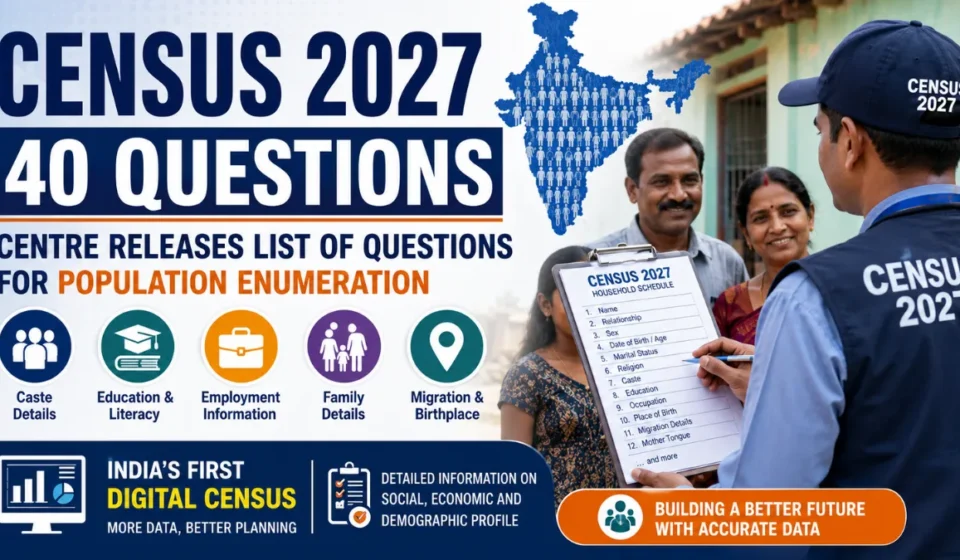
Census 2027 40 Questions: Centre Releases List of Questions to Be Asked During India’s Population Census

India’s upcoming population census will include a major new component as the Centre has officially notified the Census 2027 40 questions that will be asked during the enumeration process. The questionnaire covers a wide range of personal, social, educational and economic details, while caste information will also be collected this time.
The inclusion of caste-related questions is being seen as one of the most significant aspects of Census 2027. India has not conducted a full caste census since 1931, making the latest decision particularly important for understanding the country’s changing social and demographic profile.
According to the notification issued by the Registrar General of India, respondents will be asked whether they belong to a Scheduled Caste (SC), Scheduled Tribe (ST) or another caste category. The government is expected to use the information collected through the census to build a broader picture of India’s social and economic conditions.
Census 2027 40 Questions Include Caste Details
The Census 2027 40 questions cover several aspects of an individual’s identity, family background, education, employment and migration history.
Among the questions, people will be asked whether they belong to a Scheduled Caste or Scheduled Tribe and, where applicable, what their caste is. The collection of caste data is considered significant because reliable nationwide caste population figures have not been available from a recent comprehensive census.
The government’s decision is also important from a policy perspective. For years, the absence of detailed caste data has been part of discussions surrounding the implementation of government welfare programmes and reservation-related policies.
A detailed caste census could provide information about the population and socio-economic circumstances of different caste groups. Such information could potentially help governments formulate policies related to education, employment, social welfare and other areas.
The Cabinet Committee on Political Affairs, chaired by Prime Minister Narendra Modi, had decided on April 30 last year to include caste enumeration in the upcoming census.
What Information Will Be Collected?
The notification issued by the Registrar General of India lists several categories of information that will be collected from respondents.
People will be asked about their marital status, age at the time of marriage, name of their spouse, nationality and religion. Questions will also cover whether a person belongs to a Scheduled Caste or Scheduled Tribe and details relating to caste.
The questionnaire will further seek information about parents, disability status, mother tongue and other languages known by the respondent. Information related to literacy and digital literacy will also form part of the census exercise.
These questions are designed to provide a broader understanding of the population beyond simply counting the number of people living in the country.
Education and Employment Questions
Education and employment will also be important parts of the Census 2027 exercise.
Respondents will be asked whether they currently attend an educational institution. They will also be required to provide information about their highest level of education, educational stream and subject.
Employment-related questions will examine whether a person worked at any time during the previous year. The census will also seek information about the person’s economic activity, occupation and the type of industry, business or service in which they are engaged.
The category of worker will also be recorded. This information can help provide a clearer picture of employment patterns and economic participation across different sections of the population.
Questions About Birthplace and Migration
Migration will be another major area covered by the census questionnaire.
People will be asked about their place of birth and where they lived previously. The census will also seek to understand why a person moved from one place to another.
Respondents may also have to provide information about how long they have been living in their current village or town after their most recent migration. Their permanent residential address will also be recorded.
These details are expected to help build a clearer picture of population movement within the country and the reasons behind migration.
Questions for Married, Widowed and Divorced Women
The census will include specific questions for married, widowed, divorced and separated women.
They will be asked about the total number of children they have, the number of children born from their current marriage and the number of children born during the previous year.
Such information can help the government understand fertility patterns and changes in family structures across different parts of the country.
Aadhaar, Mobile Number and Other Details
The notification also mentions questions concerning certain identity and service-related details.
Respondents will be asked about the location where they received their COVID-19 vaccination. Information regarding the total number of bank accounts held by an individual will also be collected.
The questionnaire will also include details related to a mobile number, Aadhaar number, voter ID number and passport number. People will additionally be asked whether they hold a driving licence.
These questions are part of the wider effort to collect detailed demographic and socio-economic information about the population.
Self-Enumeration Option Before Door-to-Door Census
The government has also provided an option for people to complete self-enumeration before the door-to-door population count begins.
According to the order, the self-enumeration window will be available from August 17 to August 31. After this period, enumerators will begin the household-level exercise.
In certain snow-covered areas, including Ladakh as well as snow-bound regions of Jammu and Kashmir, Himachal Pradesh and Uttarakhand, population enumeration is scheduled to take place from September 1 to September 30.
The population census in the remaining parts of India will be conducted during the next phase.
Also read: EPFO New Withdrawal Rules: Employees Can Withdraw Up to 75% of PF Balance in Certain Situations
Census 2027 Will Be India’s First Fully Digital Census
Another major feature of the exercise is its digital nature. According to the Centre, Census 2027 will be India’s first fully digital population census.
This means digital technology will be used extensively for collecting and processing census information. The shift is expected to make the process more technology-driven and reduce dependence on traditional paper-based methods.
The use of digital systems is also expected to streamline the collection, management and processing of the large volume of information generated during the census.
Why Census 2027 Is Important
The upcoming census will provide much more than a simple count of India’s population. The information collected will cover social identity, education, employment, migration, family structure, language, literacy, digital literacy and several other aspects of everyday life.
The decision to collect caste information adds another important dimension to the exercise. Since India has not had a comprehensive caste census since 1931, the new data could offer a more current picture of the country’s caste composition.
At the same time, the detailed information on education, employment, migration and household characteristics could help policymakers understand changing demographic trends.
The Census 2027 40 questions therefore represent a wide-ranging effort to capture information about India’s population and living conditions. With caste enumeration returning to the national census and the entire exercise moving towards a digital format, Census 2027 is expected to be one of the most significant population-counting exercises in modern India.
Also read: EPFO New Withdrawal Rules: Employees Can Withdraw Up to 75% of PF Balance in Certain Situations