

Four-Year GPS Tracking Study Challenges Long-Held Beliefs About Flamingo Migration
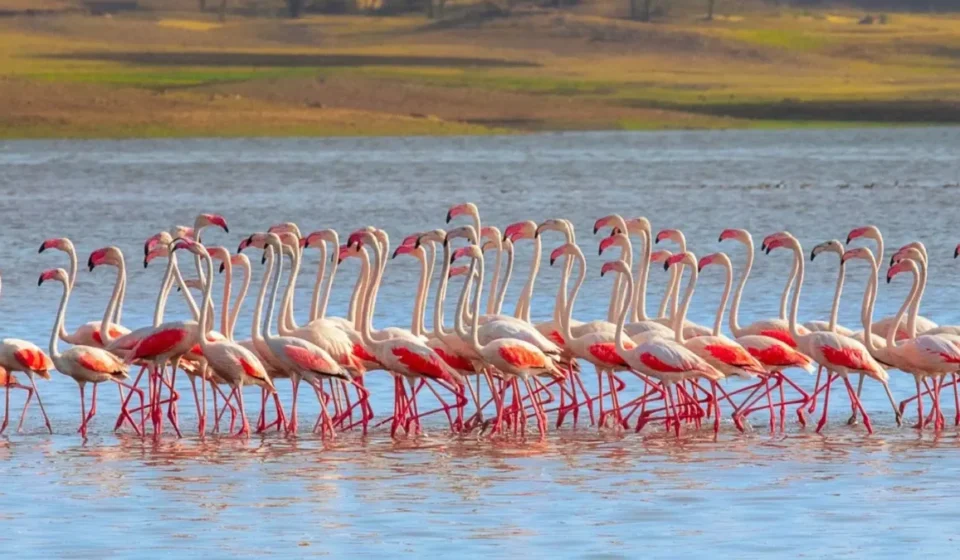
The Wildlife Institute of India has brought new attention to the movement and habitat patterns of flamingos in Gujarat’s Kutch region. A four-year scientific study has revealed that flamingos, despite being widely associated with long-distance migration, spend most of their lives within the Kutch landscape rather than travelling across countries for extended periods.
The finding is particularly significant because Kutch is internationally recognised as one of Asia’s most important habitats for flamingos. For years, the movement of these striking birds has often been viewed through the lens of long-distance migration. However, detailed GPS tracking carried out by researchers from the Wildlife Institute of India has shown that the reality is more closely linked to seasonal movement within the Kutch region.
The research involved continuous tracking of eight adult flamingos over several years. The birds included four Greater Flamingos and four Lesser Flamingos. Researchers used GPS-GSM transmitters to monitor their movements and collected more than 670,000 location records between May 2019 and December 2023.
The enormous amount of location data allowed scientists to understand how the birds use different wetlands, breeding grounds and feeding areas throughout the year. The results show that Kutch itself provides a remarkably diverse range of habitats that allow flamingos to meet their requirements during different seasons.
Wildlife Institute of India Conducts Extensive Four-Year Study
The study was prepared by researchers associated with the Endangered Species Management division of the Wildlife Institute of India. Harindra Baraiya, Gaurav Sirola, Anju Baroth and R. Suresh Kumar were involved in the research.
The findings were published in the scientific journal Avian Research. Rather than relying only on occasional field observations, the researchers used GPS-GSM technology to follow individual birds over a prolonged period.
This long-term approach provided an opportunity to observe movements that may otherwise remain unnoticed. Flamingos can travel between wetlands depending on rainfall, water levels, food availability and other environmental conditions. By tracking their locations continuously, researchers were able to identify important areas used by the birds during both breeding and non-breeding periods.
More than 670,000 location records were collected during the study period. These records helped researchers create a detailed picture of flamingo movements across the Kutch landscape.
The results showed that the tagged birds generally remained within Kutch. Their movements were not completely static, however. Instead, the birds regularly shifted between different wetland habitats as environmental conditions changed.
This means that Kutch should not be viewed simply as a single flamingo habitat. It functions as a connected landscape containing several types of wetlands that serve different purposes during different periods of the year.
Flamingos Move Between Wetlands According to Seasonal Conditions
One of the most important findings of the study is that flamingos adjust their movements according to changing environmental conditions.
During the breeding season, the birds use areas of the desert that become temporarily flooded by seasonal water. After the breeding period, they move towards a wider range of inland, coastal and saline wetlands.
Rainfall plays an important role in this pattern. The arrival of the southwest monsoon can change the availability, depth and salinity of water across the region. These changes also influence the availability of food, forcing flamingos to adjust their daily movements.
The GPS data therefore show that the birds are highly dependent on the wider Kutch ecosystem. Protecting only one breeding location may not be enough to secure their future because the birds require several different habitats throughout the year.
The study also found a strong connection between flamingos and wetlands that they have used previously. Researchers observed what is known as site fidelity, meaning that birds show a strong tendency to return to familiar locations after completing their breeding cycle.
This behaviour makes the continued protection of established breeding and feeding sites especially important.
Flamingo City Remains a Major Breeding Ground
The famous Flamingo City in the Great Rann of Kutch has long been recognised as one of the most important flamingo breeding locations in Asia.
According to the study, Flamingo City was particularly important for Greater Flamingos during the breeding period. The area provides suitable conditions for nesting when seasonal water creates the necessary environment.
Lesser Flamingos, meanwhile, showed somewhat different habitat preferences. They were recorded using wetlands around Kuda and Bela in the Great Rann, while salt pans in the Little Rann of Kutch were also used for nesting.
The findings demonstrate that the two flamingo species do not depend on the landscape in exactly the same way.
Their different habitat preferences are important for conservation planning because a strategy designed around only one type of wetland may fail to protect the full range of areas required by both species.
Greater and Lesser Flamingos Show Different Movement Patterns
The Wildlife Institute of India study also revealed a clear difference in the daily movements of Greater Flamingos and Lesser Flamingos.
Greater Flamingos travelled an average of about 23.4 kilometres per day during the breeding season. During the non-breeding period, their average daily movement dropped to around 12.4 kilometres.
Lesser Flamingos showed a similar seasonal pattern, although their movements were slightly greater. During breeding, they travelled an average of approximately 27.6 kilometres per day. Outside the breeding period, their average daily movement was around 16.6 kilometres.
The difference indicates that breeding places additional demands on the birds and results in more frequent movement between locations.
Seasonal environmental changes can also influence this activity. During and after the southwest monsoon, changes in water spread, water depth, salinity and food availability can cause flamingos to travel more frequently in search of suitable feeding locations.
These movements highlight the importance of maintaining connectivity between wetlands. If one wetland becomes unsuitable because of human activity or environmental changes, birds may need access to alternative areas nearby.
Lesser Flamingos Depend Heavily on Saline Habitats
Another significant finding concerns the habitat preferences of the two species.
Lesser Flamingos showed a particularly strong dependence on saline ecosystems. During the non-breeding period, they spent more than half of their time in salt pans, while approximately one-third of their time was spent around mudflats.
This dependence places the species in close proximity to areas that are also heavily influenced by human activity.
Salt production is an important economic activity in parts of Kutch and the Little Rann. At the same time, these salt-producing areas can become important habitats for wildlife. The study therefore highlights the complicated relationship between human land use and flamingo conservation.
Greater Flamingos were more flexible in their habitat use. They were recorded using both saline and freshwater or less saline habitats.
This difference between the species means that conservation efforts need to account for multiple habitat types rather than focusing exclusively on traditional protected areas.
Rare Long-Distance Journeys Were Also Recorded
Although the overall study showed that flamingos spend most of their time within Kutch, researchers also recorded some remarkable long-distance movements.
One of the most notable examples involved a Greater Flamingo named Hanj. The bird spent around three months at Pakistan’s Miani Hor Ramsar wetland before making an extraordinary journey towards Afghanistan.
The bird then travelled approximately 2,130 kilometres and returned to Kutch in only about 42 hours.
Another Greater Flamingo, named Padhar, was also recorded visiting Miani Hor in Pakistan. These movements demonstrate that although most flamingos remain closely connected to Kutch, some individuals can undertake substantial cross-border journeys.
A Lesser Flamingo named Rohar was recorded travelling approximately 540 kilometres to Ajmer.
These observations are important because they show that flamingo behaviour cannot be described simply as either local or migratory. Most of the tracked birds remained within the Kutch landscape, but individual birds were capable of undertaking significant journeys when environmental or biological conditions required it.
The discovery adds another layer to scientists’ understanding of flamingo movement patterns in western India and neighbouring regions.
Why Kutch Is So Important for Flamingo Conservation
The findings underline the exceptional ecological importance of Kutch.
The region contains a combination of seasonal wetlands, coastal areas, mudflats, salt pans and other habitats that flamingos use at different times of the year. These areas together form a larger ecological network.
The study suggests that protecting one location in isolation will not provide adequate protection for the birds.
A flamingo may breed in one location, feed in another wetland and spend the non-breeding period in a salt pan or coastal habitat. If any of these areas are damaged, the effects can extend beyond that particular site.
This is why conservation at the landscape level is becoming increasingly important.
Human Activities Are Creating New Challenges
Researchers have warned that several forms of human activity are putting pressure on wetlands used by flamingos.
Wetland filling is one of the concerns because it can directly reduce the amount of habitat available to birds. Industrial waste can also affect water quality, while agricultural chemicals may enter wetland systems and alter their ecological conditions.
Energy development is another emerging issue. Wind and solar power projects are expanding across many parts of western India, including landscapes that can overlap with important wildlife habitats.
Such developments do not necessarily mean that conservation and infrastructure development cannot coexist. However, the study indicates that careful planning is necessary to prevent critical habitats and movement routes from being damaged.
The challenge is particularly important for flamingos because their habitat requirements extend beyond formally protected areas.
Conservation Cannot Stop at Protected Area Boundaries
One of the strongest messages emerging from the Wildlife Institute of India research is that flamingo conservation must extend beyond officially protected areas.
The birds were found to rely heavily on salt pans, mudflats and other areas that may not have the same level of legal protection as designated wildlife habitats.
This makes cooperation between government agencies, conservation organisations, local communities and people involved in salt production particularly important.
Conservation planning should take into account how wetlands are connected and how water conditions change throughout the year. Maintaining suitable water regimes and protecting feeding and nesting areas can help ensure that flamingos continue to use the region.
A landscape-level approach can also help identify areas where development should be carefully regulated to minimise its impact on wildlife.
A New Understanding of Flamingo Life in Kutch
The four-year study has changed the way researchers can look at flamingo movement in Kutch.
The birds are capable of travelling hundreds or even thousands of kilometres, but the majority of their daily and seasonal lives are closely connected to the Kutch landscape. Rather than constantly moving across international borders, many flamingos shift between different wetlands within the region according to seasonal conditions.
The study also shows that Greater Flamingos and Lesser Flamingos have different habitat preferences and movement patterns. Both species, however, depend on a healthy and interconnected wetland ecosystem.
The GPS tracking data provide valuable evidence for future conservation planning. With more than 670,000 location records collected over four years, researchers have been able to build a detailed understanding of where the birds travel, where they breed and which habitats they use during different periods.
For Kutch, the findings reinforce something that local communities and wildlife observers have witnessed for years: the region is far more than a temporary stop for flamingos. It is a critical part of their life cycle.
Also read: Vantara’s Elephant Mission Goes Global: 260+ Elephants, Major Welfare Push Across India
What the Study Means for the Future of Flamingos
The biggest lesson from the research is that flamingo conservation cannot depend solely on protecting famous breeding sites.
Flamingos require a functioning network of wetlands throughout the year. Their survival depends on suitable feeding grounds, nesting locations, mudflats, salt pans and coastal habitats remaining available and ecologically healthy.
The Wildlife Institute of India study provides important scientific evidence to support a broader approach. Conservation measures need to consider water management, wetland protection, pollution control, responsible development and the preservation of important movement areas.
The long-distance journeys recorded during the research also demonstrate that Kutch is connected to wetlands beyond India. The movements involving Pakistan and Afghanistan show that cooperation across regions and national boundaries may become increasingly important for understanding and protecting highly mobile bird populations.
For now, the central message is clear: flamingos may be famous for their ability to travel long distances, but Kutch remains at the heart of their lives.
The four-year GPS study has provided a much clearer picture of that relationship. It shows that the future of flamingos will depend not only on protecting their most famous breeding grounds, but also on preserving the wider network of wetlands and human-used landscapes that sustain them throughout the year.
For a region as ecologically significant as Kutch, protecting these interconnected habitats is therefore not simply about saving a single bird species. It is about maintaining the health of an entire wetland ecosystem on which wildlife and local communities depend.