

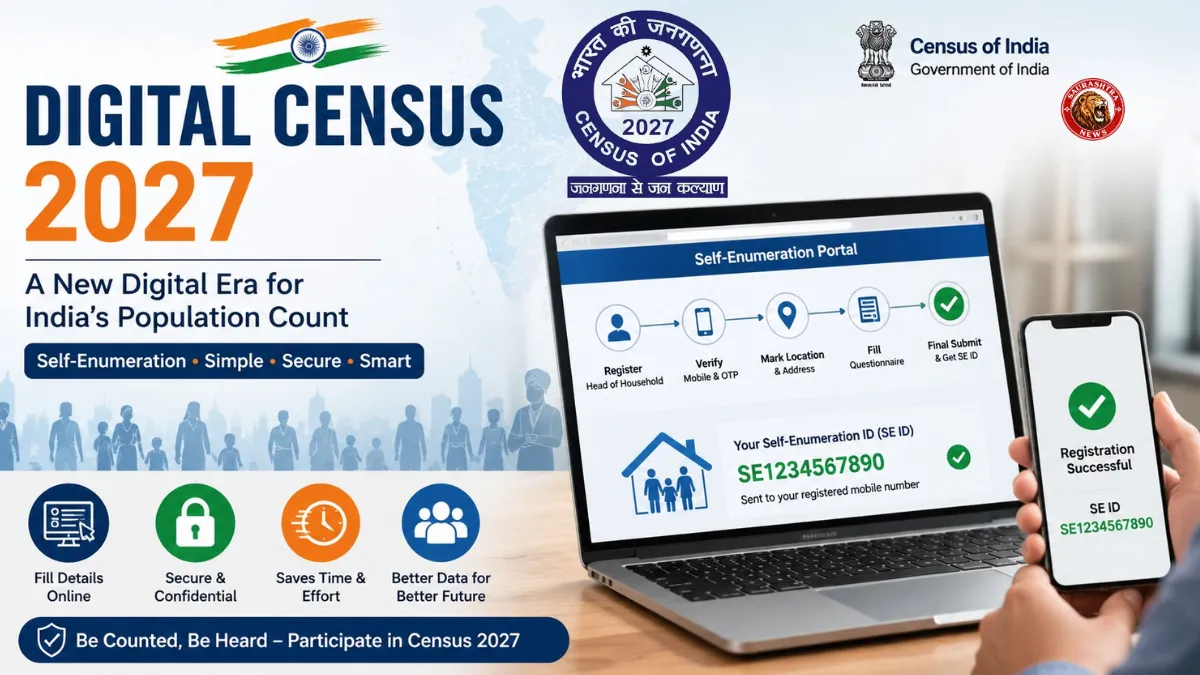
Digital Census Registration 2027: Step-by-Step Guide to India’s First Fully Digital Census Process

Digital Census Registration 2027: India is preparing for a major transformation in the way population data is collected, with Census 2027 set to become the country’s first fully digital census exercise. The government plans to modernize the decades-old enumeration system by introducing mobile-based data collection and a self-enumeration facility that allows citizens to submit their household details online.
The new Digital census Registration process is designed to make data collection faster, more accurate, and easier for citizens. Instead of relying only on physical paperwork during door-to-door visits, census officials will use mobile applications to record information digitally. Citizens will also have the option to complete their census details themselves through an official online portal before an enumerator visits their home.
What Is Digital Census Registration?
Digital census Registration is an online self-enumeration system introduced as part of Census 2027. Through this process, households can directly submit their demographic and housing information using the official Census portal.
The initiative is expected to reduce paperwork, minimize data-entry errors, and improve the speed of processing census information across the country. Officials believe the digital model will also help improve transparency and make the entire exercise more efficient.
Under the system, every household that completes self-enumeration online will receive a unique Self-Enumeration ID (SE ID). This ID can later be shown to the census enumerator during the official verification visit.
How the Digital Census Will Work
Unlike previous census operations that relied heavily on manual forms, Census 2027 will use smartphone and tablet-based applications for data collection. Enumerators visiting homes will digitally upload household details in real time.
Citizens who prefer to complete the process on their own can use the self-enumeration feature available through the government’s dedicated portal. The platform allows users to fill in their information securely and save drafts before final submission.
The government has indicated that the digital process aims to make participation simpler while maintaining the accuracy of national population records.
Step-by-Step Guide for Digital Census Registration 2027
1. Visit the Official Self-Enumeration Portal
To begin the Digital census Registration process, users need to access the official self-enumeration portal provided by the Census authorities. After opening the website, select the relevant State or Union Territory from the drop-down menu and complete the captcha verification.
2. Register the Head of Household
The next step involves registering the head of the household. Users must enter the full name of the household head along with a valid 10-digit mobile number. An email address can also be added, although it is optional.
Authorities have clarified that the name of the household head cannot be modified after registration, so users are advised to enter details carefully.
3. Verify Mobile Number Through OTP
Once the registration details are submitted, a One-Time Password (OTP) will be sent to the registered mobile number. Entering the OTP successfully verifies the account and activates access to the self-enumeration form.
4. Select Preferred Language
The portal supports multiple regional and national languages. Users can choose the language they are most comfortable with before proceeding to the questionnaire section.
5. Enter Address and Mark Location
Applicants must then provide detailed address information, including district name, PIN code, and house details. The portal also includes a digital map feature that allows users to pinpoint the exact location of their residence.
This mapping feature is expected to help improve location accuracy and streamline verification during the census exercise.
6. Complete Household Questionnaire
The form includes questions related to housing conditions, family members, and household information. Users can fill out the questionnaire gradually, as the system allows draft saving during the self-enumeration window.
This feature is especially useful for larger families that may require additional time to gather accurate details.
7. Final Submission and SE ID Generation
After reviewing all information, users can click on the “Final Submit” option. Once submitted, the system generates a unique Self-Enumeration ID or SE ID, which is sent through SMS to the registered mobile number.
8. Share the SE ID With the Enumerator
When the official census enumerator visits the residence, households that completed Digital census Registration must provide their SE ID. The enumerator can then retrieve and synchronize the digitally submitted data with the government census system.
Also Read: Gujarat RFO Transfer: Major Overhaul in Forest Department After Long-Pending Changes
Why Census 2027 Matters
The census plays a crucial role in national planning, policy decisions, welfare schemes, and resource distribution. Population data collected during the exercise helps governments make decisions related to healthcare, education, infrastructure, and employment programs.
By moving to a digital-first system, the government aims to modernize one of the country’s largest administrative exercises while making the process more accessible for citizens.
Experts believe the introduction of Digital census Registration could significantly improve efficiency and reduce delays traditionally associated with large-scale census operations.